
Beyond Image Generation: Why the Future of E-commerce Visuals Belongs to the AI Design Agent
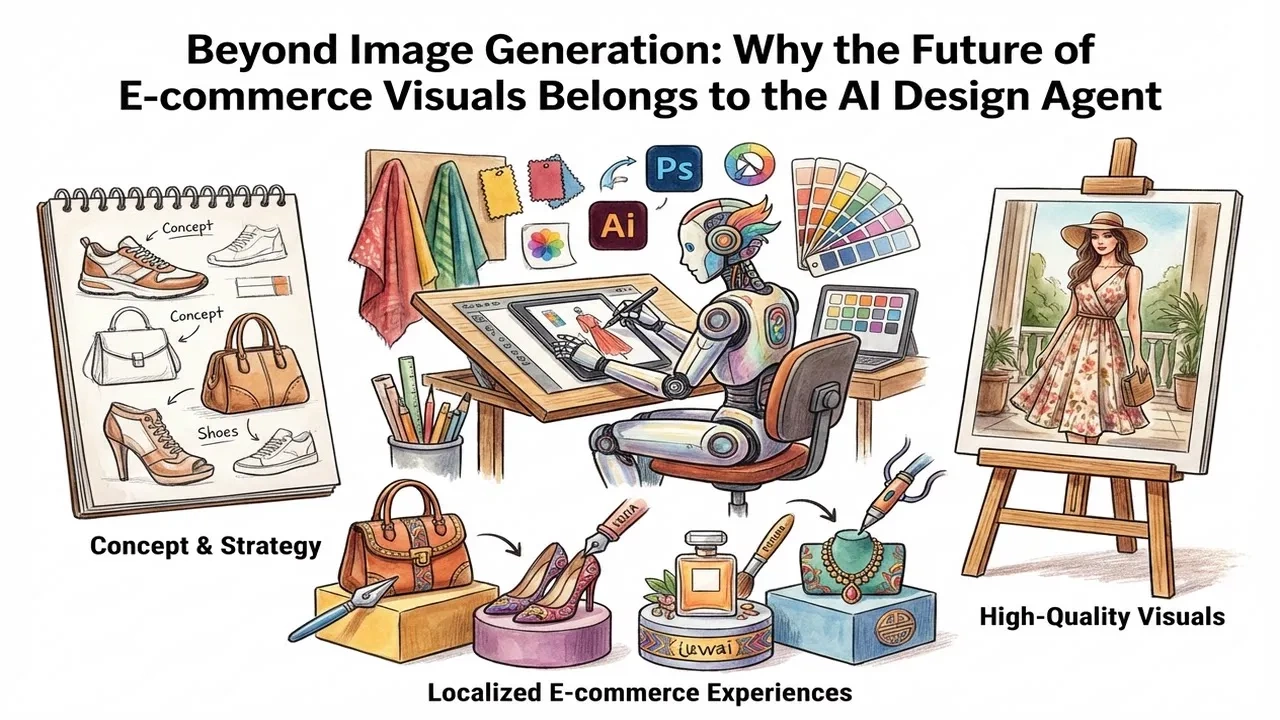
1. The Bottleneck: Why Traditional Design Scales Poorly
Consider the workflow of a typical mid-sized cross-border seller. Launching a new SKU involves scheduling a photographer, editing raw photos, hiring a designer to create banners for the website, resizing assets for Instagram and TikTok, and translating visuals for different target markets (eg, US, Japan, Germany).
This linear process is fundamentally unscalable.
-
Time-to-Market Lag: It takes days or weeks to get visual assets ready for a trend that might be over in 48 hours.
-
Inconsistency: Different freelancers produce different styles, diluting brand identity.
-
Localization Costs: Creating multilingual e-commerce marketing assets often requires hiring native designers for each region, an expense few SMEs can justify.
The market doesn’t need another tool to edit pixels; it needs a system to manage the design lifecycle. This is the gap where the AI design agent enters the conversation—not as a tool for artists, but as a growth partner for merchants.
2. The Rise of AI Product Photography
The first major disruption we are witnessing is the obsolescence of the traditional white-background studio shoot. AI product photography has evolved from glitchy experiments to photorealistic, commercial-grade outputs.
For a long time, sellers struggled with generic background removers that left products looking floating and fake. Modern AI solutions now understand lighting physics, shadows, and material reflections. They can place a sneaker on a wet urban street or a skincare bottle on a sunlit marble counter in seconds.
The Impact on Etsy and Niche Markets
This is particularly game-changing for platforms that rely on “vibes” and storytelling. Etsy product photography , for example, demands a rustic, handmade, or lifestyle aesthetic. A white background often hurts conversion on Etsy.
With advanced AI photography, a seller can take a simple photo of a handmade candle on their kitchen table and transform it into a cozy, winter-themed lifestyle shot that fits the Etsy aesthetic perfectly. This democratizes high-end visual marketing, allowing small sellers to compete with major brands.

Raw images transforming into high-quality, ready-to-use product images
3. Why You Need an AI Design Agent, Not Just a Tool
There is a critical distinction that many sellers miss: the difference between an AI tool and an AI design agent for e-commerce .
-
An AI Tool (eg, Midjourney, Photoshop AI): Requires you to be the pilot. You need to know prompt engineering. You need to manually iterate. It generates images, but it doesn’t understand “sales.”
-
An AI Design Agent: Acts as an autonomous team member. It understands the context of e-commerce.
An AI design agent for e-commerce doesn’t just ask “What do you want to draw?” It asks, “What are you selling, and to whom?” It understands that a hero banner needs empty space for text (copy space). It knows that a Facebook ad needs a 1:1 ratio while a Story needs 9:16.
By automating the decision-making process in design—choosing layouts, matching colors, and adapting formats—an agent frees the merchant to focus on strategy rather than pixel-pushing.
4. Mastering Platform Context: From Etsy to Shopify
Every e-commerce platform has its own visual language. What works on Amazon (clean, informative, white background) often fails on Instagram (moody, lifestyle, dynamic).
An effective design workflow must adapt a single core asset into multiple variations. This is where etsy product photography differs vastly from independent station (DTC) requirements.
-
Etsy: Needs warmth, human touch, and “imperfection.”
-
Shopify/Brand Site: Needs brand consistency, authority, and high-definition zoom capabilities.
-
Social Media: Needs trend-driven, high-contrast visuals to stop the scroll.
Manually re-shooting or re-designing for these channels is a massive resource drain. An intelligent agent system ingests the product data once and “syndicates” the visual design across all these channels, ensuring the vibe fits the platform while the product remains the hero.
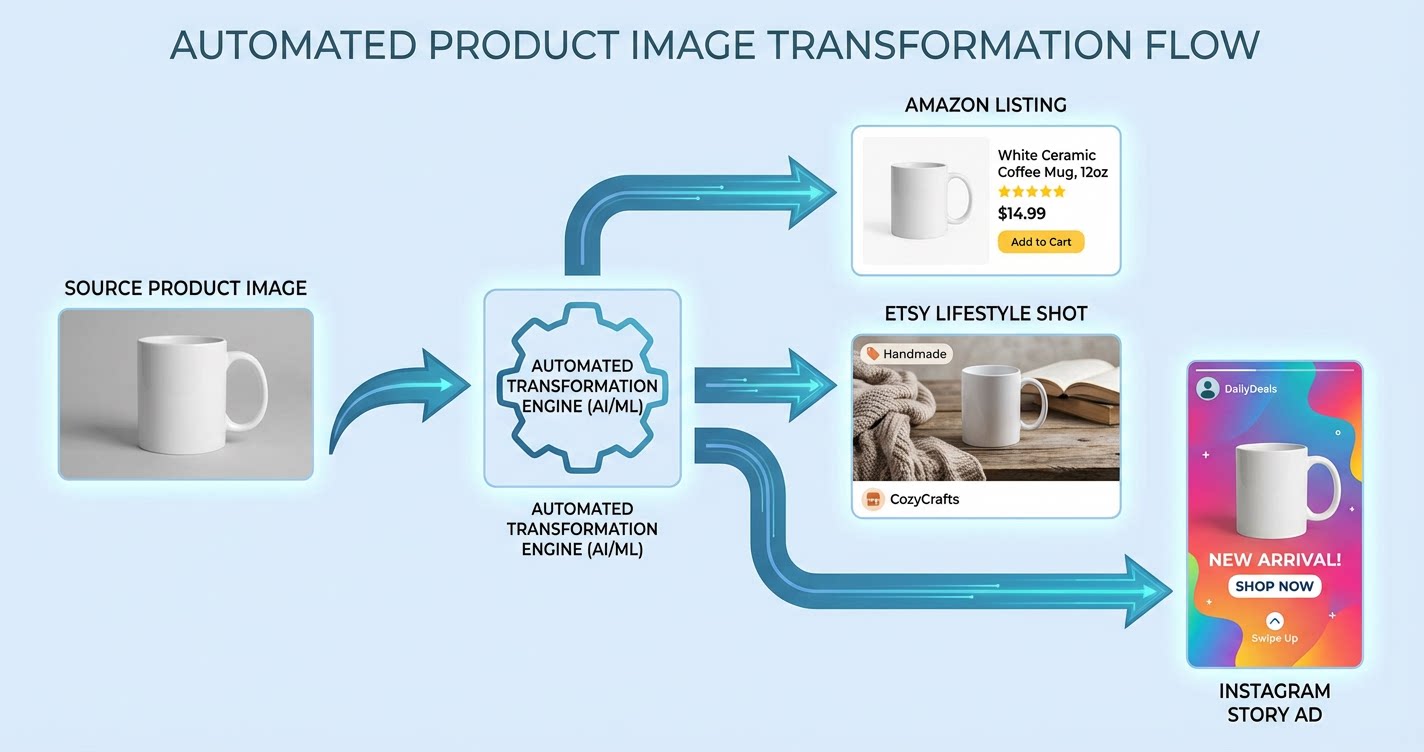
Automated product image transformation flow
5. Conversion-Focused & Trend-Aware Design
Pretty images are vanity metrics; sales are sanity metrics. This brings us to the most vital capability of modern SaaS solutions: being a conversion focused design tool .
A generic AI artist creates art. A conversion-focused agent creates assets designed to click. It utilizes data on what visual elements drive CTR (Click-Through Rate). For instance, it might automatically add a “Best Seller” badge, adjust the contrast of the CTA button, or position the product to guide the user’s eye toward the “Buy” button.
Staying Ahead of the Curve
Furthermore, the visual trends in e-commerce change rapidly. One month, “Acid Graphics” are in; the next, “Quiet Luxury” minimalism dominates.
A trend aware design tool continuously analyzes market data to understand current aesthetic preferences. It ensures your marketing materials don’t look dated. If you are selling fashion accessories, the AI agent should suggest backgrounds and layouts that align with current color trends (like the “Pantone Color of the Year”) without you needing to research them manually.
6. The Challenge of Scale: Brand Guidelines & Multilingual Markets
For growing brands, the biggest fear regarding AI is the “hallucination” of their brand identity. AI might generate a beautiful image but distort the logo or use the wrong shade of blue. This is unacceptable for serious businesses.
Protecting the Brand Identity
To solve this, we are seeing the rise of AI design with brand guidelines . Advanced agents allow sellers to upload their Brand Kit (fonts, color hex codes, logo usage rules). The AI then acts as a brand guardian, ensuring that every generated banner, email header, or product photo strictly adheres to these rules. It locks the brand assets while generating the creative environment around them.
Global Expansion Made Easy
For cross-border sellers, the challenge multiplies with every new country entered. AI tools for multilingual e-commerce marketing are becoming essential.
It’s not just about translating text on a banner. It’s about cultural adaptation.
-
Scenario: A skincare brand launching in Japan might need a “clean, soft, minimalist” visual style.
-
Scenario: The same brand launching in Brazil might need “vibrant, colorful, energetic” visuals.
An AI design agent can take the same SKU and generate localized visual assets that resonate with local cultural nuances, all while keeping the text in the correct language and font.
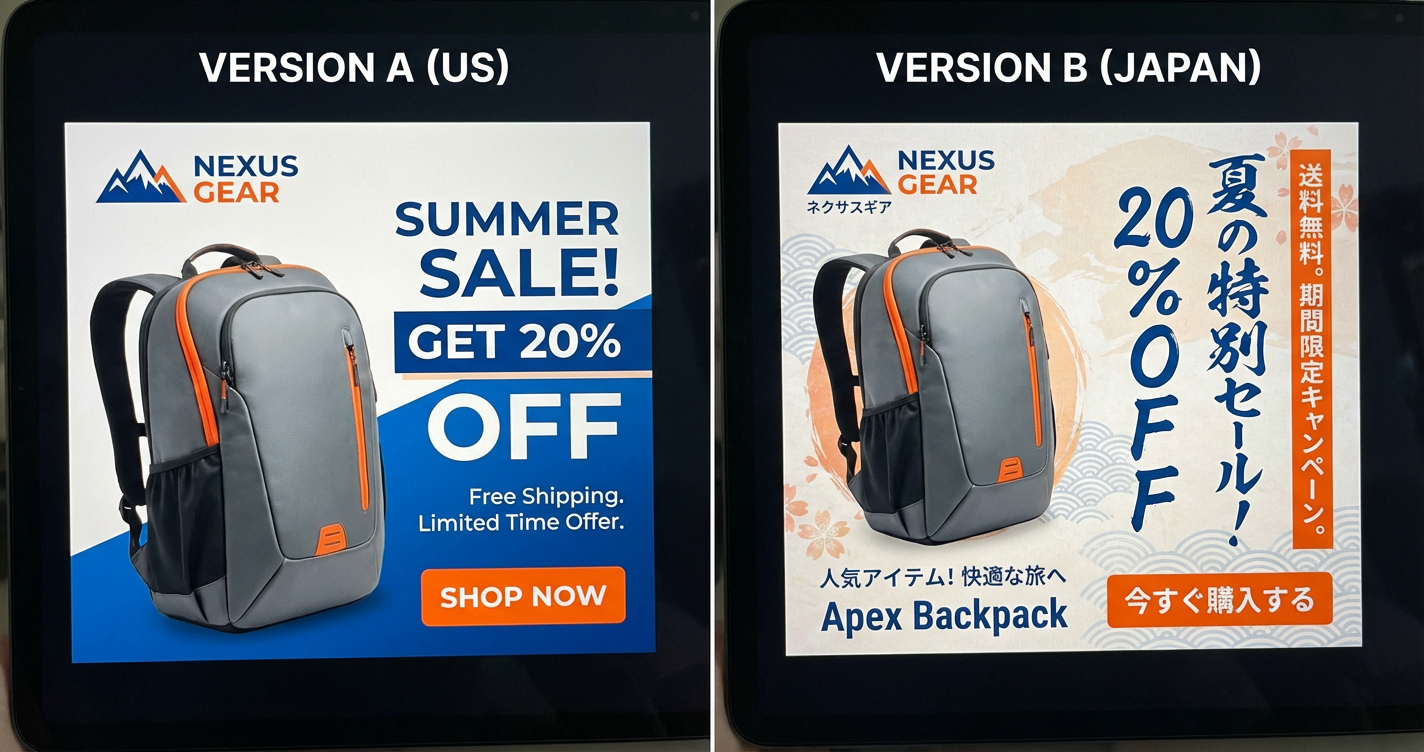
Same product be localized in different regions by AI agent
7. Aidge: The Integrated Solution for Modern Sellers
The market is flooded with fragmented tools—one for removing backgrounds, one for generating images, and another for adding text. However, forward-thinking platforms like Aidge are building what can be truly described as AI design agents for e-commerce .
Unlike generic image generators that require endless prompting, Aidge is engineered specifically for the merchant’s workflow. It integrates the core capabilities we’ve discussed:
-
AI Product Photography: It transforms basic product shots into studio-grade visuals suitable for everything from Etsy product photography to high-end Shopify storefronts.
-
Brand Compliance: It supports AI design with brand guidelines , ensuring that as you scale content production, you don’t lose your visual identity.
-
Global Reach: It serves as one of the few dedicated AI tools for multilingual e-commerce marketing , helping sellers localize visuals instantly.
-
Performance Driven: At its core, it acts as a conversion focused design tool , prioritizing layouts and styles that are proven to sell.
By positioning itself as a comprehensive agent rather than just a pixel editor, Aidge allows marketing teams to produce weeks’ worth of localized, on-brand, and trend aware design assets in minutes.
8. Conclusion: Reshaping E-commerce Growth
The era of relying solely on expensive photoshoots and manual graphic design is drawing to a close for the high-volume e-commerce sector. The introduction of the AI design agent represents a fundamental shift in how brands communicate with customers.
For the cross-border seller, this technology is the great equalizer. It allows a team of five to output the visual volume of a team of fifty. It allows a local brand to market globally with native-level visual fluency.
As we move forward, the most successful brands will not be those with the largest design departments, but those who best leverage AI agents to deliver the right visual, to the right customer, at the right time.